




Introduction#
A crochet puppy is one of those heart-melting projects that makes people instantly say, “Aww!”—even before you finish the ears. It’s the perfect handmade gift for dog lovers, baby showers, birthdays, and holiday surprises, because it feels personal and comforting in a way store-bought plushies rarely do. This crochet pattern is designed to create a sitting puppy with a gentle expression, floppy ears, a rounded muzzle, a classic little dog nose, and sturdy paws that help it sit upright without tipping.
Explore more beginner amigurumi crochet patterns in our pattern library.
The best part is that it looks detailed while still being approachable. You don’t need complicated stitches or advanced shaping to get an adorable result. The “realism” comes from smart placement: where you put the muzzle, how you position the eyes, and how you attach the ears and legs so the puppy has that sweet, slightly curious look. This crochet tutorial breaks it all down step by step so you can make a puppy that looks polished and gift-worthy—no stress, no guesswork.
If you’re looking for an easy crochet pattern that teaches strong amigurumi basics and gives you a finished toy you’ll be proud of, this puppy is a perfect project.
Detailed Description of the Crochet Pattern#
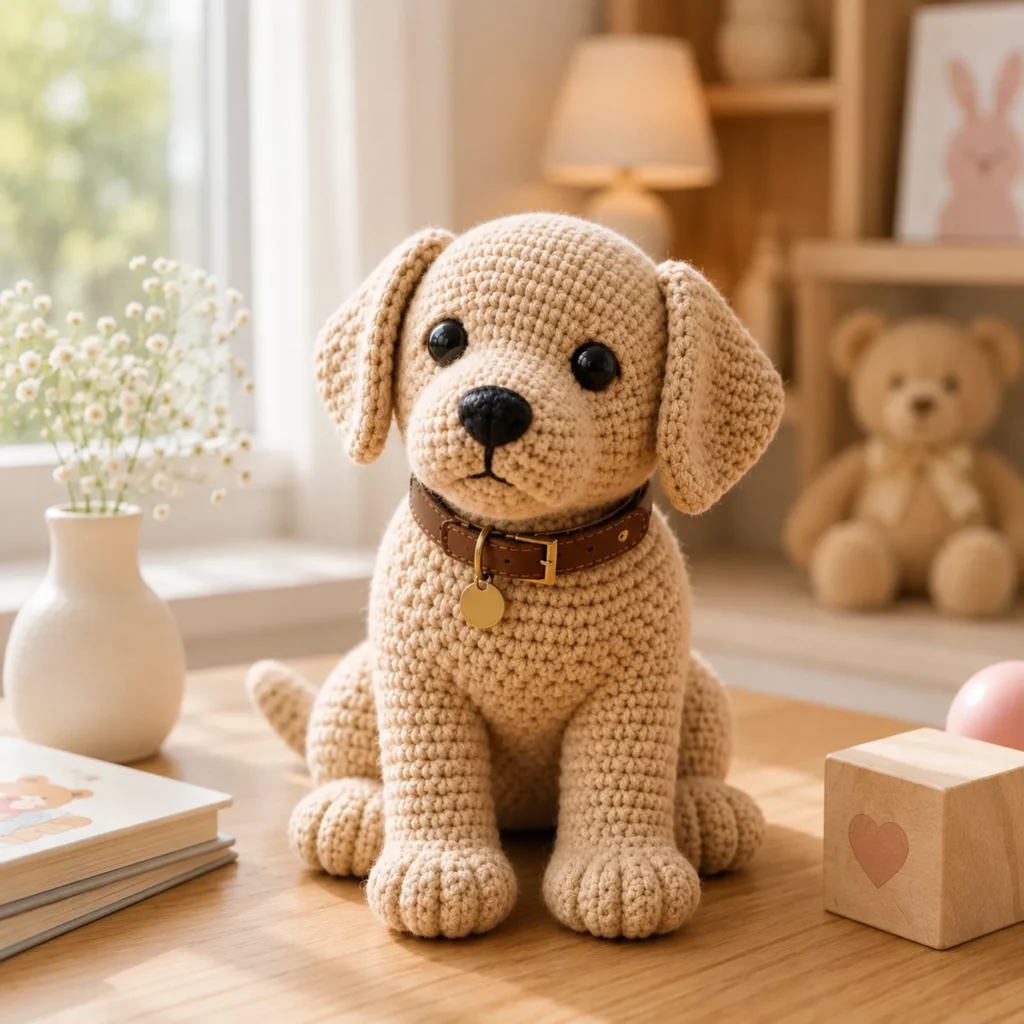
This is a sitting dog amigurumi with classic puppy proportions: a round head, a slightly raised muzzle, floppy ears, a compact body that sits upright, and chunky front paws.
Design features you’ll crochet
Rounded head with smooth shaping
Defined muzzle that creates a “snout” profile
Safety eyes placed for a friendly, gentle expression
Floppy ears attached slightly to the sides for a natural look
Sitting body with a stable base
Front paws that rest forward
Back legs that support sitting posture
Small tail that sits behind or curls to the side
Optional collar accessory for extra charm
How it’s built
The puppy is made from separate parts (head, body, muzzle, ears, legs, paws, tail). You stuff and shape each piece, then sew them together. That gives you full control over the final expression and posture.
Skill Level Explanation#
Skill level: Confident Beginner
You should feel comfortable with
Magic ring
Single crochet (sc)
Increase (inc) and decrease (dec)
Working in continuous rounds
Basic sewing and assembly
You’ll learn and practice
Neat eye placement for expression
Stuffing and shaping for a smooth muzzle
Attaching limbs symmetrically so the puppy sits properly
Simple embroidery for the mouth line (optional)
This is crochet for beginners friendly because the stitchwork is straightforward. The “skill” is mostly in finishing, and you’ll get clear guidance for that.
Materials Needed#
Yarn
Worsted weight (Category 4) acrylic or cotton is ideal for this dog.
Cotton gives crisp stitch definition.
Acrylic gives a softer plush feel.
Suggested colors
A: Main puppy color (cream, beige, light brown, gray)
B: Ear color (same as A or a shade darker)
C: Nose/mouth (black or dark brown yarn or embroidery thread)
Optional: collar color (brown, red, or any accent)
Hook
Use a smaller hook than the yarn label suggests for tight amigurumi stitches.
Worsted: 3.0–4.0 mm
If your stitches look gappy, go down a size.
Notions
Stitch marker
Tapestry needle
Scissors
Fiberfill stuffing
Safety eyes (10–14 mm depending on size)
Optional: safety nose or embroidered nose
Optional: felt circles behind eyes for extra security
Optional: small collar tag charm (for display, not for babies)
Safety note
If making for babies or toddlers, embroider eyes and avoid hard accessories.
Stitches & Techniques Explained#
Abbreviations
MR = magic ring
sc = single crochet
inc = increase (2 sc in one stitch)
dec = invisible decrease
sl st = slip stitch
ch = chain
BLO = back loop only
FLO = front loop only
( ) repeat
[ ] stitch count
Invisible decrease
Insert hook into the front loop of the next stitch, then the front loop of the following stitch, yarn over, pull through, yarn over, pull through two. This keeps the face smooth.
Clean color change
Change color on the final yarn-over of the stitch before the new color begins.
Stuffing for smooth shaping
Use small pieces of stuffing. Add gradually and press into shape as you go so the muzzle and head stay rounded, not lumpy.
Step-by-Step Instructions#
Finished size
With worsted yarn and a 3.5 mm hook, expect about 8–11 inches (20–28 cm) tall depending on stuffing and ear length.
Notes before you start
Work in continuous rounds unless stated
Use a stitch marker
Stuff firmly but don’t stretch stitches
Pin pieces before sewing
Color Key
A main body color
B optional darker ear shading
C black/dark embroidery
Head (A)
Round 1: 6 sc in MR [6]
Round 2: inc around [12]
Round 3: (sc, inc) around [18]
Round 4: (2 sc, inc) around [24]
Round 5: (3 sc, inc) around [30]
Round 6: (4 sc, inc) around [36]
Round 7: (5 sc, inc) around [42]
Rounds 8–12: sc around [42]
Eye placement
Place safety eyes between Rounds 10–11, about 8–10 stitches apart.
For a softer puppy look, place them slightly wider apart.
For a more “cartoon cute” look, place them a little closer.
Shape toward neck
Round 13: (5 sc, dec) around [36]
Round 14: sc around [36]
Round 15: (4 sc, dec) around [30]
Round 16: sc around [30]
Start stuffing firmly.
Round 17: (3 sc, dec) around [24]
Round 18: (2 sc, dec) around [18]
Round 19: (sc, dec) around [12]
Round 20: dec around [6]
Fasten off and close. Leave a long tail for sewing to body.
Muzzle (A)
Round 1: 6 sc in MR [6]
Round 2: inc around [12]
Round 3: (sc, inc) around [18]
Rounds 4–5: sc around [18]
Fasten off with a long tail. Lightly stuff so it holds shape.
Nose
Option A: embroider a nose triangle in black thread
Option B: attach a small safety nose centered near the front
Sew muzzle centered below the eyes. Tip the top edge slightly upward so it looks like a snout, not a flat patch.
Ears (Make 2, B or A)
These are floppy, rounded ears.
Round 1: 6 sc in MR [6]
Round 2: (sc, inc) around [9]
Round 3: (2 sc, inc) around [12]
Rounds 4–10: sc around [12]
Round 11: (4 sc, dec) around [10]
Rounds 12–13: sc around [10]
Fasten off with a long tail. Do not stuff. Flatten.
Sew ears slightly lower than the top of the head, angled forward just a little for a sweet expression.
Body (A)
This body is shaped to sit upright.
Round 1: 6 sc in MR [6]
Round 2: inc around [12]
Round 3: (sc, inc) around [18]
Round 4: (2 sc, inc) around [24]
Round 5: (3 sc, inc) around [30]
Round 6: (4 sc, inc) around [36]
Round 7: (5 sc, inc) around [42]
Rounds 8–12: sc around [42]
Widen base for sitting stability
Round 13: (6 sc, inc) around [48]
Rounds 14–16: sc around [48]
Shape upward
Round 17: (6 sc, dec) around [42]
Round 18: sc around [42]
Round 19: (5 sc, dec) around [36]
Round 20: sc around [36]
Stuff firmly, flattening the bottom slightly so it sits.
Close top
Round 21: (4 sc, dec) around [30]
Round 22: (3 sc, dec) around [24]
Round 23: (2 sc, dec) around [18]
Fasten off leaving a long tail for sewing head on. Close opening as needed while sewing.
Front Legs (Make 2, A)
Round 1: 6 sc in MR [6]
Round 2: inc around [12]
Round 3: sc around [12]
Round 4: (4 sc, dec) around [10]
Rounds 5–10: sc around [10]
Stuff lightly, flatten top, fasten off with long tail.
Front Paws (Make 2, A)
If you want extra chunky paws like a plush puppy, add separate paws.
Round 1: 6 sc in MR [6]
Round 2: inc around [12]
Round 3: sc around [12]
Fasten off with tail. Lightly stuff.
Sew paws to the bottom of the front legs, then attach legs to the front of the body.
Optional toe detail
Embroider 3 small stitches on each paw.
Back Legs (Make 2, A)
Back legs are slightly thicker to support sitting.
Round 1: 6 sc in MR [6]
Round 2: inc around [12]
Round 3: (sc, inc) around [18]
Round 4: sc around [18]
Round 5: (4 sc, dec) around [15]
Rounds 6–10: sc around [15]
Stuff firmly, flatten top, fasten off.
Attach back legs low and slightly wide on the sides of the body so the puppy balances.
Tail (A)
Round 1: 6 sc in MR [6]
Rounds 2–6: sc around [6]
Fasten off with tail.
Sew tail to the lower back. Angle slightly to one side for a playful look.
Assembly
Attach muzzle first
This helps you place the mouth line correctly.
Embroider mouth
Stitch a short line down from the nose, then a tiny curved smile on one or both sides.
Attach ears
Pin both ears, check symmetry from the front, then sew.
Attach head to body
Pin head centered. Sew firmly with multiple passes, especially under the chin and back of neck.
Attach legs and paws
Pin all limbs, set the puppy down on a flat surface, adjust until it sits evenly, then sew.
Add collar (optional)
You can use a real doll collar for display or crochet one.
Simple crochet collar
Ch enough to fit around neck, sl st to join, then sc around once. Add a small button or stitch a tiny tag.
Common Mistakes and How to Avoid Them#
Puppy won’t sit upright
Stuff the bottom of the body more firmly
Place back legs wider
Flatten the base while stuffing
Add a small weight pouch inside the bottom if needed (optional)
Face looks off-center
Mark the head center with a stitch marker
Pin muzzle and eyes placement before sewing
Check from the front and side before stitching
Ears look uneven
Count rounds carefully
Pin both ears before sewing
Measure distance from top of head to each ear
Muzzle looks flat
Lightly stuff muzzle
Sew the top edge tighter so it angles outward slightly
Add a tiny bit more stuffing right behind the muzzle for a snout shape
Stuffing shows through
Use a smaller hook
Tighten tension
Avoid overstuffing
Expert Tips for Better Results#
Use slightly larger eyes for a cuter puppy look and slightly smaller eyes for a more realistic dog look
To create gentle cheek shaping, add a few stitches pulling from the inside of the head just under the eyes toward the muzzle edges
Add a tiny white highlight stitch on each eye if you embroidered eyes
If you want a “lab puppy” look, keep the ears shorter and wider
If you want a “beagle puppy” look, make ears longer by adding 4–6 rounds
Variations and Customization Ideas#
Spotted puppy
Sew small circle spots in a darker shade onto the body.
Puppy with a heart patch
Crochet a small heart applique and sew on the chest.
Sleeping puppy
Embroider closed eyes and add tiny lashes.
Holiday puppy
Add a scarf or tiny Santa hat.
Keychain mini puppy
Use DK yarn and reduce body rounds for a smaller version.
Different breeds by small changes
Longer ears and a slightly longer muzzle for hound types
Shorter ears and rounder muzzle for teddy-bear style pups
Add a small floppy tongue applique for extra personality
Benefits of This Crochet Project#
A timeless crochet pattern that’s always giftable
Beginner-friendly stitches with a polished result
Customizable to many dog colors and “breeds”
Teaches core amigurumi shaping and assembly skills
Perfect for nursery décor, dog lovers, and market makes
Looks cute even without extra accessories
Internal Linking Suggestions#
How to Crochet Invisible Decreases for Amigurumi
Best Yarn for Amigurumi Toys
How to Place Safety Eyes for Cute Crochet Faces
Beginner Guide to Sewing Amigurumi Parts Neatly
Easy Crochet Animal Patterns Collection
FAQ Section#
Is this crochet dog pattern beginner-friendly?
Yes. The stitches are basic, and the shapes are simple. The main challenge is careful assembly, which the tutorial guides you through.
What yarn is best for a crochet puppy?
Worsted cotton or acrylic works great. Cotton shows stitches clearly, acrylic feels softer and plush.
What size safety eyes should I use?
For worsted yarn, 10–14 mm is typical. If you want a cuter look, go slightly larger.
Can I make it baby-safe?
Yes. Embroider the eyes and nose instead of using safety pieces, and skip any detachable accessories like tags or charms.
How do I make the puppy bigger or smaller?
Change yarn weight and hook size, or add an extra increase round to the head and body for a larger plush.
How do I keep the muzzle centered?
Mark the face center line with pins, sew the top edge first, then sides, then bottom, checking alignment as you go.
Conclusion#
This sitting crochet puppy is the kind of crochet pattern you’ll want to make more than once—because it’s simple, sweet, and easy to customize. With a smooth head, floppy ears, a gentle muzzle, and sturdy paws, it looks polished and gift-worthy while still being beginner-friendly.
If you tell me your yarn weight and hook size, I can suggest the best eye size and the exact round placement so your puppy’s face turns out perfectly balanced and adorable.