




Introduction#
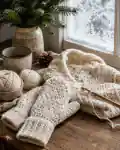
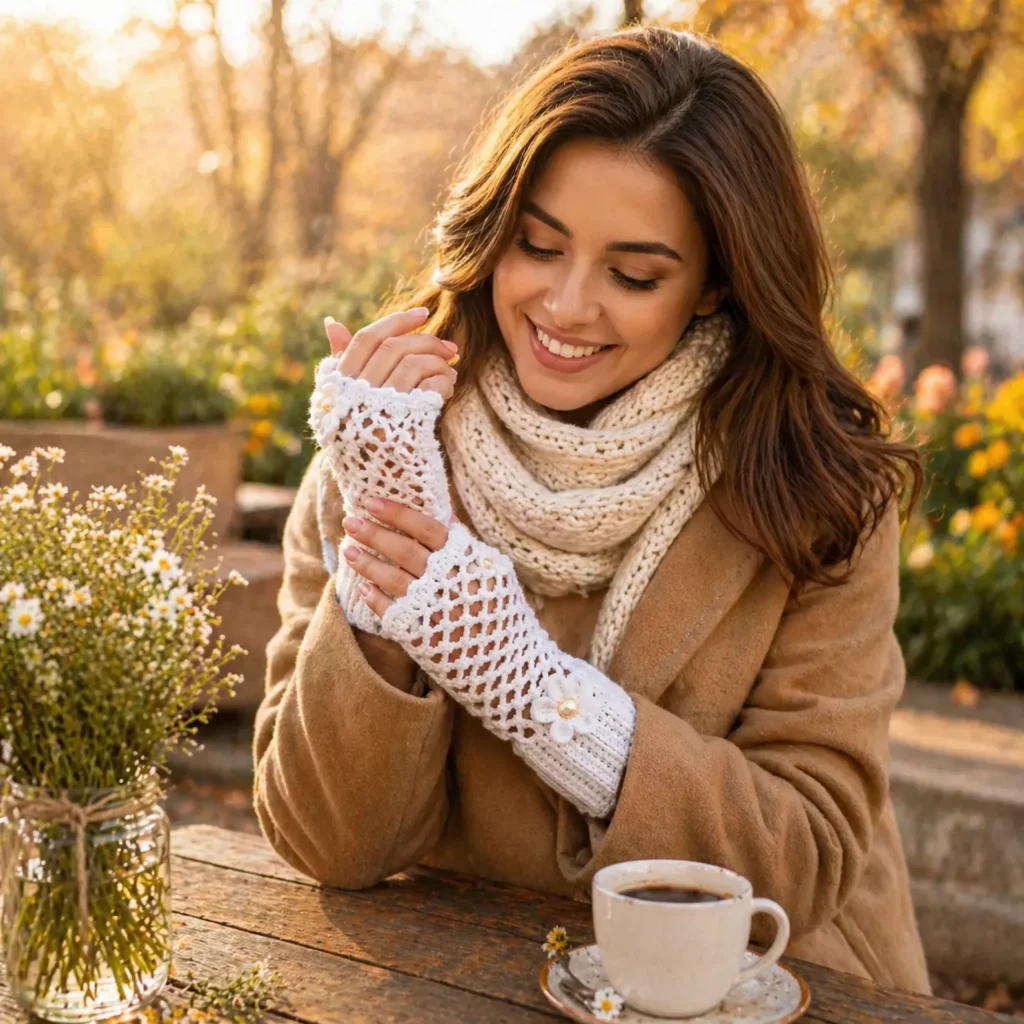
Fingerless gloves are one of those crochet projects that feel instantly useful the moment you slip them on. They keep your hands warm while leaving your fingers free for texting, typing, driving, crocheting, or sipping a hot drink. And when you add a light, lacy texture, they look less like “winter gear” and more like a stylish accessory you can wear from fall through spring.
Explore more beginner scarves crochet patterns in our pattern library.
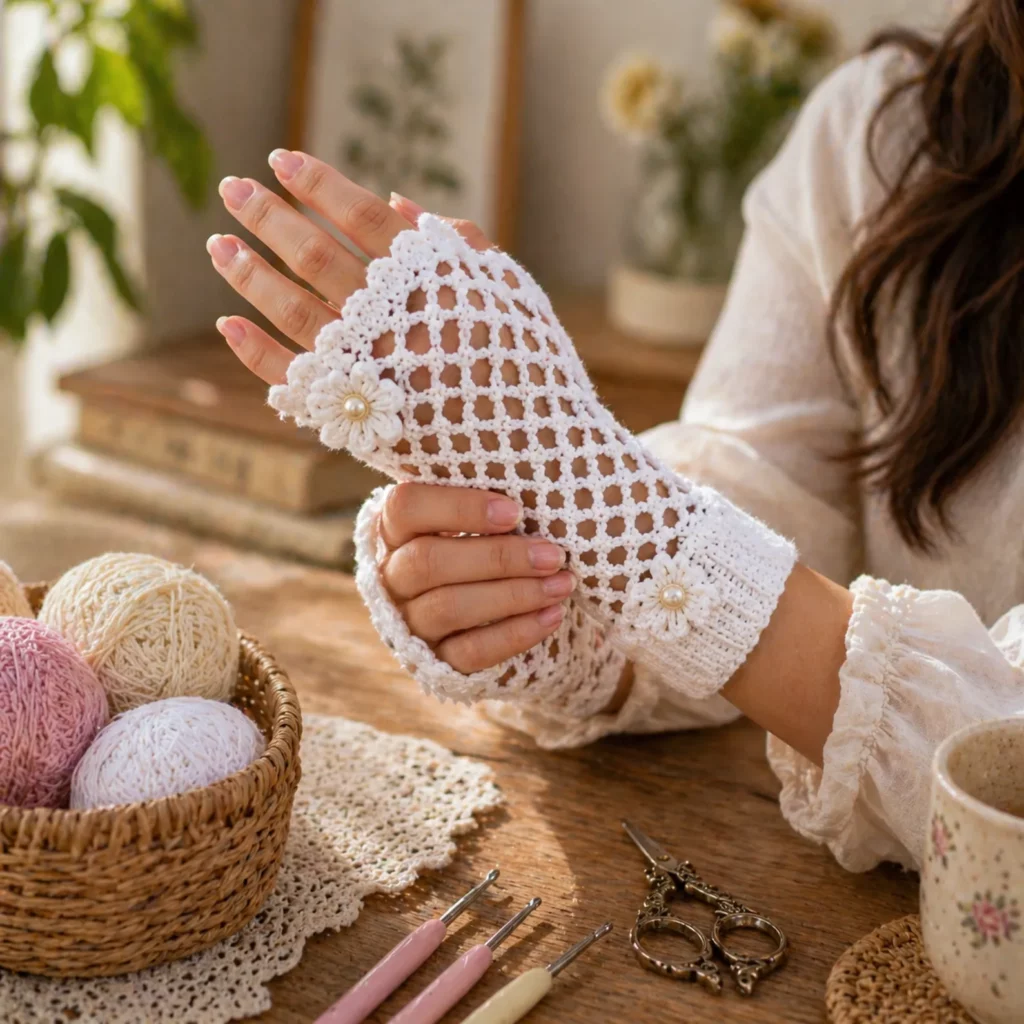
This crochet pattern is for a pair of elegant, wrist-hugging fingerless gloves with three features that make them extra wearable:
- A snug ribbed cuff that stays put (no sliding around).
- A lace body that’s warm without feeling bulky.
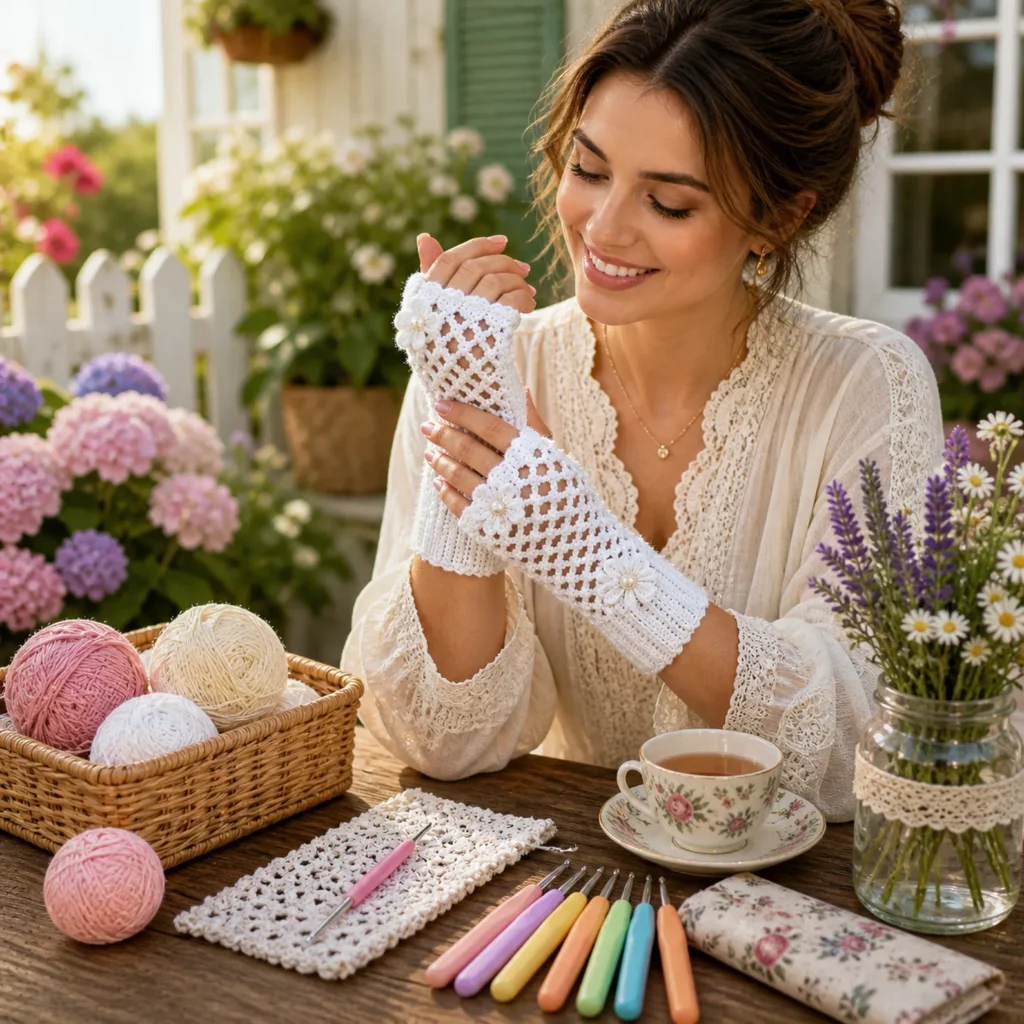
- A sweet flower accent with a button-like center that gives the gloves a polished, boutique finish.
The pattern is written like a true crochet tutorial with sizing guidance, stitch explanations, and beginner-friendly assembly. If you’re looking for a free crochet pattern that you’ll actually wear (or gift), this is it.
Detailed Description of the Crochet Pattern#
These fingerless gloves are worked from the wrist up. You start with a ribbed cuff, then transition into a lace stitch pattern that creates an airy, diamond-like texture. The glove finishes with a gentle scalloped edge at the hand opening and a thumb opening formed by skipping stitches (no complicated shaping required).
The flower embellishment is optional, but it’s a great detail for gifts. You can sew it near the wrist, on the side of the hand, or even use it to anchor a small strap if you prefer a snugger fit.
What you’ll make:
- One right glove and one left glove (mirror placement of the thumb opening)
- A lace pattern that stretches comfortably
- A structured cuff that keeps the glove secure
- A removable-style embellishment (you can also swap for a bow, charm, or plain finish)
Skill Level Explanation#
This is an easy-to-intermediate project.
Beginner-friendly skills:
- Working in rows and rounds
- Single crochet and double crochet
- Chains and slip stitches
- Simple seaming
- Basic counting
Skills that feel “intermediate” but are still approachable:
- Working a lace repeat consistently
- Creating a thumb opening by chaining and skipping stitches
- Adjusting fit with measurements
If you can make a simple scarf or dishcloth, you can absolutely make these gloves—especially because the lace repeat is predictable once you get through the first few rows.
Materials Needed#
Yarn
For fingerless gloves, choose yarn that is soft on skin and has good stitch definition.
Recommended yarn:
- DK (#3) or light worsted (#4) for a balanced fit (warm but not bulky)
- Fiber options: acrylic, wool blend, cotton blend (choose what feels best on your hands)
Best choices for comfort:
- Soft acrylic (easy care)
- Merino or wool blend (warmest)
- Cotton/bamboo blend (great for mild climates)
Hook
- DK yarn: 3.5–4.0 mm
- Light worsted: 4.0–4.5 mm
Choose a hook that creates a fabric you like—lace should be open, but not sloppy.
Notions
- Stitch markers (helpful for thumb placement)
- Yarn needle
- Scissors
- 2 small buttons (optional, for flower centers)
- Optional: a small pearl bead or shank button for a dressy look
Stitches & Techniques Explained#
Abbreviations (US terms)
- ch = chain
- sl st = slip stitch
- sc = single crochet
- hdc = half double crochet
- dc = double crochet
- BLO = back loop only
- sk = skip
- sp = space
- rep = repeat
Ribbed cuff (BLO rows)
Working single crochet in the back loop only creates stretch that mimics knitting. It’s perfect for cuffs because it hugs the wrist and keeps the gloves secure.
Lace diamond mesh (easy lace repeat)
The lace in this crochet tutorial uses a simple structure: chains create open spaces, and double crochet posts create the “columns.” The result is airy but still warm because the fabric doubles in thickness where the posts line up.
Thumb opening (no scary shaping)
Instead of shaping a thumb gusset, we create a thumb opening by:
- skipping a small section of stitches
- chaining across that gap
- continuing the round as normal
Later, you can add a neat edge around the thumb opening if you want a cleaner finish.
Step-by-Step Instructions#
These instructions are written as made-to-measure so you can get a great fit without guessing. You’ll still get stitch counts and a simple path, but measuring ensures the gloves fit real hands.
Measurements to take
- Wrist circumference
- Palm circumference (around knuckles, excluding thumb)
- Hand length from wrist to base of fingers
Typical sizing guide (approximate):
- Small: palm 6.5–7.25 in
- Medium: palm 7.25–8 in
- Large: palm 8–9 in
Make the ribbed cuff
You’ll crochet a strip, then seam it into a ring.
Foundation: ch 11 (adjust for cuff height)
- 10 stitches gives a slim cuff
- 12–14 stitches gives a taller cuff
Row 1: sc in 2nd ch from hook, sc across, turn.
Row 2: ch 1, sc BLO across, turn.
Repeat Row 2 until the strip length matches your wrist circumference (snug, but not tight).
Tip: The cuff should stretch comfortably over your hand but sit firmly on your wrist.
Join the cuff into a ring:
Fold cuff strip in half, short ends together.
Sl st (or sew) the ends together through both layers to form a tube.
Turn the cuff so the seam is on the inside.
Build the glove body from the cuff
Now you’ll work in rounds along the long edge of the cuff.
Round setup: ch 1, work sc evenly around the cuff edge.
Aim for an even number of stitches so the lace repeat lands nicely.
A common approach is 1 sc per row end of the cuff strip.
Join with sl st.
Lace round repeat
Here’s an easy lace that matches the open, vertical-diamond vibe:
Lace Round A: ch 3 (counts as dc), ch 1, sk 1, dc in next st rep around, join.
Lace Round B: ch 3, dc in next dc, ch 1, dc in next dc rep around, join.
Repeat Lace Round A and Lace Round B until the glove reaches the base of your thumb (usually 2–3 inches above the cuff depending on hand length).
If you want a denser lace:
- Replace ch 1 with ch 2 for bigger openings
If you want a tighter lace: - Keep ch 1 and use DK yarn with a smaller hook
Create the thumb opening
Try the glove tube on your hand (yes, mid-project fittings are your friend). Mark where your thumb naturally sits.
For most sizes, a thumb gap of 6–10 stitches works well.
At the start of the round, place a stitch marker where you want the opening to begin.
Work your lace pattern until you reach the marker, then:
- ch 6–10 (depending on desired thumb opening width)
- sk the same number of stitches on the glove body
- continue the lace pattern around as normal
Join the round.
Next round: work into the chain stitches as if they are regular stitches/spaces. This stabilizes the opening.
Continue to hand length
Keep repeating the lace rounds until the glove reaches the base of your fingers.
You want the glove to stop right before your fingers begin bending—this keeps it comfortable.
Finish the top edge (hand opening)
For a neat finish, work one of these options:
Simple edge: one round of sc around, join and fasten off.
Scalloped edge (prettier): sl st, ch 2, 3 dc in next st, ch 2, sl st in next st rep around.
Optional thumb edging
This step makes the thumb opening look more polished.
Join yarn at the thumb opening.
Work sc evenly around the opening and join.
If it feels tight, add a few increases (2 sc in one spot) to relax it.
Make the second glove
Repeat the same steps, but place the thumb opening on the opposite side.
Easiest method: lay the first glove flat with seam down, note which side the thumb opening is on, and mirror it.
Flower Embellishment#
This small flower adds a pretty focal point and gives the gloves a boutique vibe.
Simple crochet flower (5 petals)
With glove yarn color or a matching accent:
- MR, ch 1, 10 sc into ring, join.
- sl st in next st, ch 3, 2 dc in same st, ch 3, sl st in same st = one petal
Repeat for 5 petals around.
Fasten off, leave a tail.
Add center
Sew on a small button or bead in the center.
Then sew the flower onto the glove near the wrist or slightly above the cuff.
Tip: If you want the flower removable, sew it to a safety pin or brooch backing instead.
Common Mistakes and How to Avoid Them#
- Gloves feel too loose: use a smaller hook, reduce chain spaces in lace, or make cuff slightly shorter so it stretches more.
- Gloves feel too tight at palm: add a few stitches when you work the first round onto the cuff (increase evenly).
- Thumb opening is awkward: adjust the chain/skip count. Too small = pinching; too large = gaping.
- Lace looks uneven: count your repeats and keep tension steady. Stitch markers at the start of rounds help a lot.
- Cuff twists: make sure your seam is straight and you’re picking up stitches evenly around.
Expert Tips for Better Results#
- Use cotton blend or soft acrylic if you want gloves that don’t itch.
- Block lightly: a gentle steam block can open lace beautifully (especially for gifts).
- If you want extra warmth, crochet a thin lining cuff (one more ribbed layer) or wear these over thin liners.
- For crisp scallops, keep the finishing round tension slightly tighter than the body.
- Make it set-worthy: crochet a matching ear warmer or headband using the same lace stitch.
Variations and Customization Ideas#
- More coverage: extend the glove length past the knuckles into a half-finger mitt style.
- Shorter wrist: reduce cuff rows for a lighter, bracelet-style glove.
- Different edging: try picot edging (ch 3, sl st into first ch) for a delicate finish.
- Different flower: swap the flower for a bow, a crochet heart, or a small granny-square motif.
- Textured version: replace lace with hdc BLO for a warmer, knit-look fabric.
- Gift pair: make one neutral pair and one bright pair—great for craft fairs and holiday gifting.
Benefits of This Crochet Project#
- Quick, wearable accessory with real daily use
- Great beginner lace practice (without advanced shaping)
- Custom fit for any hand size
- Easy to personalize with flowers, buttons, and color choices
- Perfect for gifts, craft fairs, and “small project” blog posts
- Works in many yarn types and seasons (light lace for spring, thicker yarn for winter)
Internal Linking Suggestions#
You may also like:
- Easy Crochet Headband Pattern
- How to Crochet Ribbing in the Back Loop Only
- Beginner Crochet Lace Stitch Tutorial
- Crochet Flower Appliqué Patterns
- Simple Crochet Scarf Patterns for Beginners
- Crochet Gift Ideas You Can Finish in a Weekend
FAQ Section#
Are fingerless gloves a good crochet pattern for beginners?
Yes. They’re mostly simple tubes with a thumb opening. This pattern uses basic stitches and a repeating lace design.
What yarn is best for fingerless gloves?
Soft DK or light worsted yarn works best. Cotton blends and soft acrylics are comfortable for everyday wear.
How do I resize this free crochet pattern?
Adjust the cuff length (wrist circumference) and add or subtract stitches in the first round to fit your palm. Then crochet more or fewer lace rounds for length.
How big should the thumb opening be?
Most people need a chain/skip section of 6–10 stitches. Start smaller if you’re unsure; you can always add a round of sc around the opening to loosen it.
Can I make these gloves warmer?
Yes. Use thicker yarn, reduce lace spacing, or add a lining cuff. You can also switch the lace body to a denser stitch like hdc BLO.
Can I wash these gloves?
Usually yes, depending on yarn. Follow the yarn label. For best shape, lay flat to dry and gently reshape.
Conclusion#
These lacy fingerless gloves are the perfect mix of cozy and pretty: a snug cuff that stays in place, an airy stitch pattern that feels light but warm, and a small flower accent that makes them feel special. Once you make one pair, you’ll probably want another—because they’re quick to crochet and easy to customize for gifts.
If you tell me your wrist circumference and palm circumference, I can convert this into exact stitch counts for small/medium/large so your gloves fit perfectly without trial and error.