













Introduction#
A round lace rug has a special kind of magic. It’s soft underfoot, brightens up a space instantly, and adds that “finished” look to a room without needing lots of extra décor. If you’ve ever admired a vintage-style doily but wished it could be big enough for the floor, this crochet pattern is for you.
Explore more beginner home decor crochet patterns in our pattern library.
This project combines the charm of classic lace crochet with the practicality of a sturdy rug. The secret is using the right yarn (usually cotton), keeping your tension consistent, and building the design in repeating rings so it grows evenly. The result is a mandala-style rug with delicate openwork, textured sections, and a pretty scalloped edge that frames the whole piece.
In this crochet tutorial, you’ll learn how to crochet the rug from the center outward, how to keep the circle flat, how to create those lace “windows” without curling, and how to block it so the pattern opens beautifully. If you’re new to lace, don’t worry. The stitches are mostly simple, and the repetition makes it easier than it looks.
Detailed Description of the Crochet Pattern#
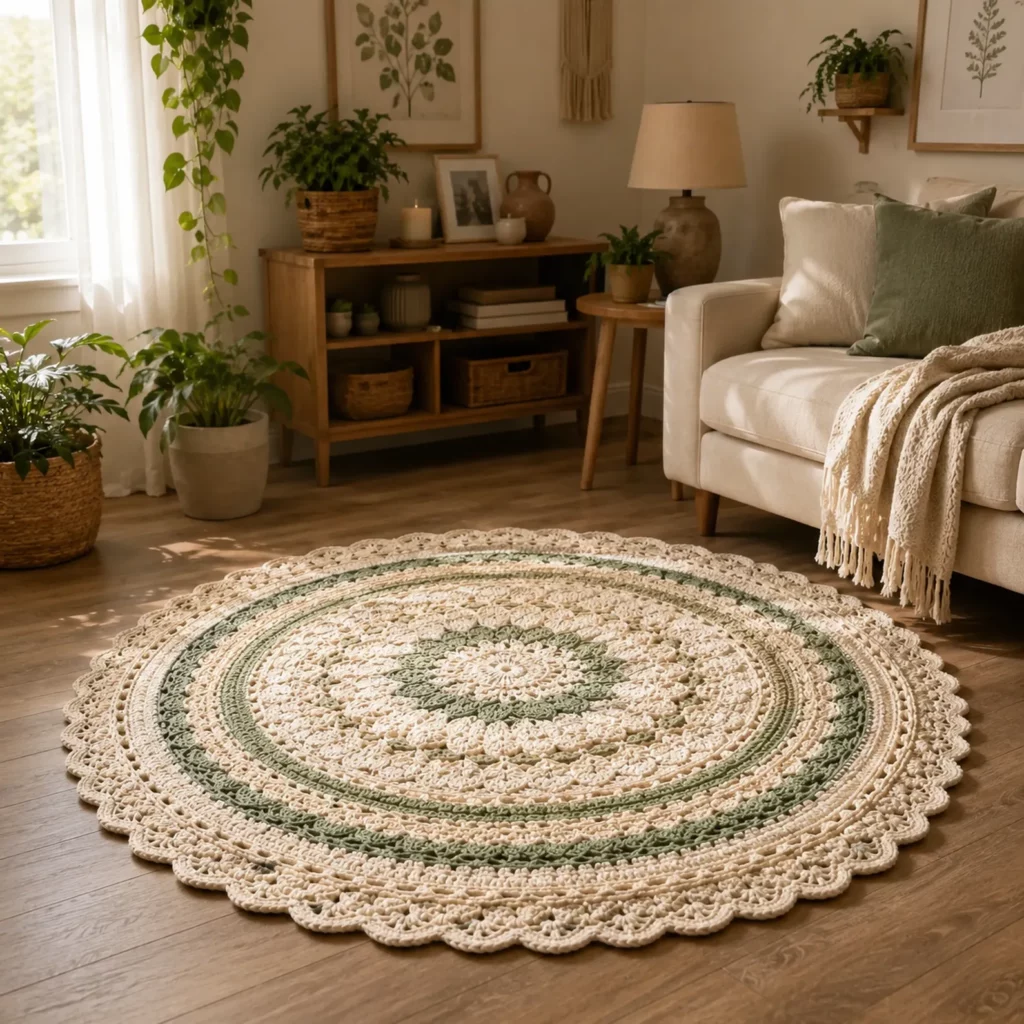
This crochet pattern creates a round mandala lace rug made in expanding rounds. The center starts with a small circle, then grows through a sequence of solid rounds, lace mesh rounds, and decorative rounds that form petal-like motifs. Near the outer edge, the pattern becomes more airy and ornamental, ending with a scalloped border that gives the rug its signature “doily” finish.
Key design features
A symmetrical mandala center that stays flat
Alternating solid and lace rounds for structure and visual contrast
Textured stitch sections that add dimension without bulk
Large outer lace ring for an elegant, open look
Scalloped edge that feels soft and decorative, not sharp
How it’s constructed
You’ll crochet in joined rounds (joining each round with a slip stitch) for clean pattern alignment. Some rounds use chain spaces to create lace openings, while others use taller stitches (double crochet, treble crochet) to create height and drape. The scalloped edge is made by repeating shell motifs evenly around the last round.
Skill Level Explanation#
Skill level: Advanced beginner to intermediate
This is a great crochet pattern if you
Know how to chain, single crochet, double crochet
Can follow a repeat pattern around
Are comfortable counting stitches and chain spaces
Want to learn lace shaping and blocking
Why it’s still beginner-friendly
The pattern is repetitive
Rounds are built in logical sections
You can stop early for a smaller rug or continue for a larger one
Even if one round feels tricky, the next usually returns to simpler stitches
Materials Needed#
Yarn options (choose based on how you’ll use it)
For a true floor rug
100% cotton yarn is best for durability and stitch definition
Look for worsted cotton (Category 4) or bulky cotton for a thicker rug
Cotton rope yarn also works if you want a heavier, more structured finish
For a decorative room rug (lighter use)
Cotton blend yarn can work, but avoid very stretchy fibers
Acrylic is not ideal for rugs because it can pill and stretch, but it’s okay for a decorative “doily rug” in low-traffic areas
Yarn amount (approximate)
36–40 in (90–100 cm) rug: 900–1400 yards (depending on yarn thickness and lace openness)
48–55 in (120–140 cm) rug: 1500–2500 yards
Tip: Lace patterns often use less yarn than solid rugs, but borders and texture add yardage quickly
Hook
Worsted cotton: 4.5–5.5 mm
Bulky cotton: 6.0–8.0 mm
Rope cotton: follow label, usually 8.0–10.0 mm
Important: choose a hook that makes a firm fabric but still allows lace openings to breathe
Tools
Stitch markers (very helpful for repeats)
Tape measure
Tapestry needle
Scissors
Blocking supplies (foam mats or towels, rust-proof pins)
Optional: spray bottle or steam iron for blocking
Stitches & Techniques Explained#
Abbreviations
ch chain
sl st slip stitch
sc single crochet
hdc half double crochet
dc double crochet
tr treble crochet
dtr double treble crochet (optional, only if you want extra height)
sp space (chain space)
rep repeat
beg beginning
Common lace instructions
“Shell” usually means multiple stitches in one space, like 5 dc in the same chain space
“V-stitch” means (dc, ch 1, dc) in the same space
“Picot” is usually ch 3, sl st into first ch (a tiny decorative point)
How to keep the rug flat
If it starts to ripple, you likely have too many stitches or your tension is loose
If it starts to curl like a bowl, you likely need more increases or your tension is tight
Blocking at the end is essential for lace rugs to look crisp
Joining rounds cleanly
Join with sl st to the first stitch of the round
Ch 1 does not count as a stitch unless stated
For dc rounds, you can begin with ch 3 (counts as dc) or use a standing dc for a cleaner start
Step-by-Step Instructions#
Notes before you start
This is a “guided free crochet pattern” written in a classic mandala style. You can follow it as-is or treat it like a base framework and add extra repeating lace rounds to increase size.
To keep it simple, I’ll give you a complete pattern to a medium-large rug and then show you how to repeat the outer section for extra diameter.
Foundation
Start with a magic ring, or ch 4 and join into a ring.
Round 1
6 sc in MR, join (6)
Round 2
Ch 3 (counts as dc), dc in same st, 2 dc in each st around, join (12)
Round 3
Ch 3, (dc, ch 1, dc) in same st, skip 1, (dc, ch 1, dc) in next st around, join (12 V-stitches)
Round 4
Sl st into first ch-1 sp, ch 3, 2 dc in same sp, (3 dc in each ch-1 sp around), join (36)
Round 5
Ch 1, sc in same st, sc around, join (36)
This round stabilizes the rug and makes the next lace ring easier to control.
Round 6
Ch 3, dc in next st, (ch 2, skip 2, dc in next 2 sts) around, join
You now have a lace mesh ring that begins opening the mandala.
Round 7
Sl st into first ch-2 sp, ch 3, 2 dc in same sp (shell start), (3 dc in each ch-2 sp around), join
Round 8
Ch 1, sc in each dc, sc in each sp, join
This “single crochet binding” keeps the lace from stretching too much.
Round 9
Ch 3, (dc, ch 1, dc) in next st, skip 1, repeat around, join
You’re building another V-stitch ring, which creates that floral/mandala rhythm.
Round 10
Sl st into first ch-1 sp, ch 3, 4 dc in same sp (shell of 5 dc), ch 1, skip next V-stitch, shell in next ch-1 sp, repeat around, join
You should see large shell petals forming.
Round 11
Ch 1, sc into top of each dc, (sc, ch 2, sc) into each ch-1 sp between shells, join
Those ch-2 corners become anchors for the next lace.
Round 12
Sl st to next ch-2 sp, ch 3, (dc, ch 2, dc) in same sp (V), ch 2, repeat V in each ch-2 sp around, join
Round 13
Sl st into first V center (ch-2), ch 3, 2 dc in same center, ch 2, 3 dc in next V center, ch 2, repeat around, join
This creates repeating “3 dc clusters” separated by chain spaces.
Round 14
Ch 1, sc in each dc, (sc, ch 3, sc) in each ch-2 sp, join
This is a shaping round that helps prepare for the outer lace ring.
Round 15
Sl st into first ch-3 sp, ch 4 (counts as tr), 2 tr in same sp, ch 2, (3 tr in next ch-3 sp, ch 2) repeat around, join
Treble stitches give the rug elegant height and openness.
Round 16
Ch 1, sc in each tr, (sc, ch 2, sc) in each ch-2 sp, join
Round 17
Sl st into next sp, ch 3, (dc, ch 1, dc) in same sp, ch 1, repeat around, join
This creates a large airy ring that will read as “lace windows” when blocked.
Round 18
Sl st into first V center, ch 3, 5 dc in same center (6-dc shell), ch 2, skip next V center, shell in next V center, repeat around, join
Round 19
Ch 1, sc across, working (sc, ch 3, sc) into each ch-2 sp between shells, join
Round 20 (Scalloped edge)
Sl st into first ch-3 sp, ch 1, (sc in sp, 7 dc in same sp, sc in same sp) to form a big scallop
Sl st into next ch-3 sp (or the next anchor point), repeat scallop around
Join, fasten off, weave in ends
If you want a deeper, more dramatic edge
After Round 20, add one more round of picots
In each scallop center dc, do (sl st, ch 3, sl st) to create tiny picots along the curve
How to make it larger
Repeat the “lace expansion block” before the scallop round
A simple expansion block is
One V-stitch round
One shell round
One sc stabilizer round
Each block adds noticeable diameter while keeping the design balanced
Common Mistakes and How to Avoid Them#
The rug ripples like a ruffle
Your stitch count increased too fast
Try dropping one extra shell or reducing chain spaces slightly
Use a smaller hook for firmer tension
The rug curls into a bowl
You need more increases or your tension is too tight
Add an increase round (like 2 dc in each V center)
Go up one hook size if your cotton is very stiff
The lace holes look uneven
Count your chain spaces carefully
Use stitch markers every repeat section
Block firmly so the lace opens evenly
The circle becomes wobbly, not round
You may be joining rounds inconsistently
Always join in the same way, and keep starting chains consistent
Rotate your work every few rounds to reduce tension bias
The scallops don’t lay flat
Your scallops may be too large for the number of anchor points
Try 5 dc scallops instead of 7 dc
Or add more anchor spaces before the edge round
Expert Tips for Better Results#
Choose cotton with good twist
A well-twisted cotton shows lace detail much better than fuzzy yarn.
Block like it matters
Lace rugs transform with blocking. Wet block if possible
Soak briefly, squeeze (don’t wring), shape, pin, and let dry fully.
Use a hidden base support for heavy pots or high-traffic spots
If this rug will be under a chair or table, consider stitching a thin non-slip mat underneath or adding a fabric backing.
Keep the center tight
The center is the “foundation.” If it’s loose, the whole rug can look sloppy. Use a smaller hook for the first few rounds if needed.
Mark your repeats
If the round has 12 repeats, place a marker every repeat. It saves time and prevents mistakes.
Variations and Customization Ideas#
Color changes
Two-tone vintage look: cream base with a soft gray ring every 3–4 rounds
Boho look: add muted earth-tone stripes (sand, clay, olive)
Modern look: one solid color with a crisp scalloped edge
Texture upgrades
Add bobble rounds for a raised dotted ring
Swap some dc rounds for hdc BLO to create ribbed circles
Add puff stitch petals in the mid-section for a more floral mandala
Size and use variations
Make it smaller for a round table topper
Stop mid-way for a large doily centerpiece
Make a matching set: small mat, medium runner, large rug
Edge variations
Tiny scallops: (sc, 5 dc, sc)
Deep scallops: (sc, 9 dc, sc)
Picot scallops: add picots along each scallop for extra lace detail
Benefits of This Crochet Project#
A crochet pattern that creates a high-end, handmade home décor piece
Works as a rug, table topper, or statement mandala décor
Great skill builder for lace crochet and shaping
Customizable size and color makes it adaptable to any room
Cotton rugs are practical, washable, and long-lasting
Makes an impressive gift for housewarmings or weddings
Internal Linking Suggestions#
Free Crochet Basket Patterns for Home Décor
How to Wet Block Crochet Lace
Best Cotton Yarn for Crochet Rugs
Beginner Crochet Mandala Tutorials
How to Add a Non-Slip Backing to Crochet Rugs
FAQ Section#
Is this a free crochet pattern okay for beginners?
Yes, as long as you’re comfortable working in the round and counting repeats. The lace looks complex, but it’s built from simple repeat rounds.
What yarn is best for a crochet lace rug?
Cotton is the best choice. It holds shape, blocks beautifully, and stays durable on the floor.
How do I keep my round rug from curling?
Check your increase rhythm and your tension. If it curls, add a gentle increase round or go up a hook size.
Do I have to block the rug?
For lace, blocking is strongly recommended. It opens the pattern and makes the scallops look smooth and intentional.
How do I wash a crochet rug like this?
If it’s cotton, you can usually hand wash or gentle machine wash. Reshape and dry flat. Always check your yarn label first.
Can I make this rug thicker?
Yes. Use thicker cotton yarn, hold two strands together, or add more solid sc rounds between lace sections.
How can I make the scalloped edge more dramatic?
Increase the shell size (use 9 dc instead of 7 dc) or add a picot round on top of the scallops.
Conclusion#
A round lace mandala rug is one of those crochet projects that looks like heirloom work but is built from satisfying, repeatable steps. With the right cotton yarn, steady stitch counting, and a good blocking session at the end, you’ll create a rug that instantly elevates your space and feels truly special.
If you tell me the exact diameter you want (for example 80 cm, 100 cm, or 120 cm), I can calculate how many expansion blocks to add and suggest the best yarn amount so you don’t run short.